By Ed Ting
Updated 10/3/09
1) Edmund Scientific 4.25" f/10.6 Reflector (ca. 1979)
($259 without motor drive, $279 with motor drive, NLA)
We buy telescopes for lots of reasons. Some of us are just getting started, some are trading up, adding to our collections, and some are paring back. And increasingly, we buy them...just because. Because we're curious how a new or different scope will perform.
Back in my misspent youth, I'd spent an unhealthy amount of time reading catalogs. You know how most normal teenagers will sometimes take a dirty magazine to bed at night with them? I took telescope catalogs with me. I'd imagine myself exploring the night sky with various scopes. I did a lot of this largely because I didn't have a penny to my name. Imagination was free.
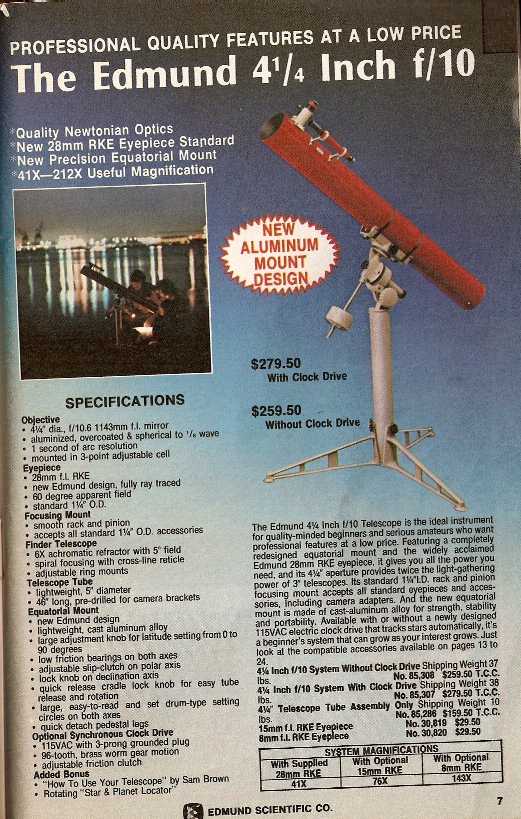
One of the most vivid series of ads I can recall was for the red-tubed Edmund Newtonians from the mid to late 1970s. Back then, Edmund was a serious player in the market, right alongside Meade, Celestron, and Criterion. I would have liked to own any of those reflectors, but it was the 4.25" f/10.6 that really caught my eye. The ad in the catalog showed a couple of kids huddled under the scope with a flashlight by the ocean, while city lights glowed in the background. Those kids looked like they were having the time of their lives. Looking back 30 years later, that ad probably did more to get me into the hobby than any other single factor. And to this day, that long, skinny Edmund was one of two telescopes that I've always wanted to own (the other is the 8" f/6 Meade Research Grade Newtonian from about the same period.)
Fast forward to last month. While cruising Astromart, what do I see but an ad for a pristine sample of that same 4.25" Edmund scope. You hardly ever see these for sale. The chemicals in my brain reacted and before I knew it, I'd arranged to buy the scope. When you adjust for inflation, I'd paid next to nothing for it.
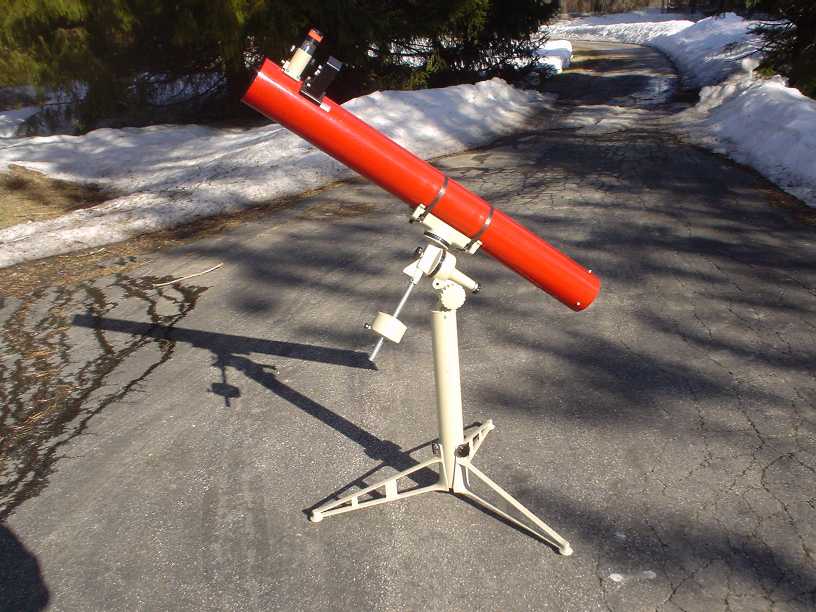
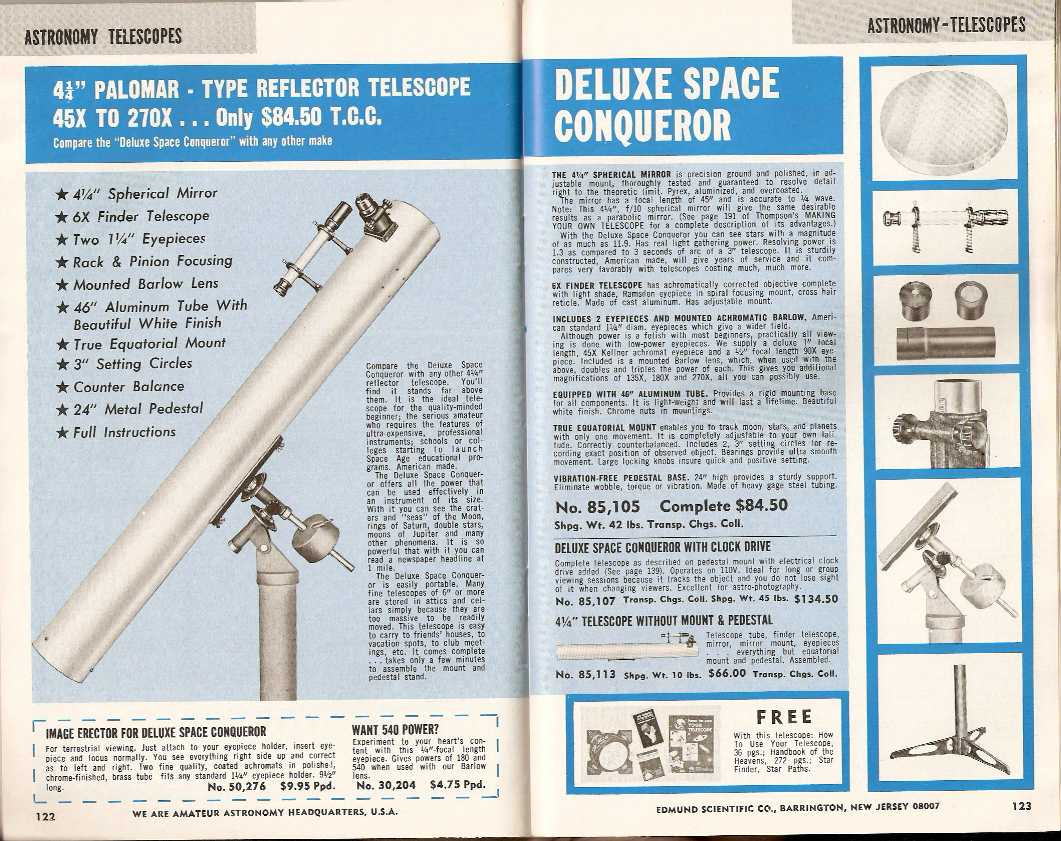
How does the scope hold up? Well...mostly, pretty well. The red-tubed Edmunds were a step up from their older white-tubed models from the 1960s. The mounts, in particular, were vastly improved, heavier, and more robust. My 4.25" unit replaced the long-lived 4.25" "Palomar" scope. Ads from the time bragged that "It is so powerful that with it you can read a newspaper headline at 1 mile." Wow! I want to do that, don't you!? And by the way, is it just me, or is "Palomar" the coolest name ever for a 4.25" telescope? They just don't market stuff this way anymore.
While my 4.25" scope had many improvements, it has some issues. Some of these are serious. The secondary is a joke - a little square mirror mounted on a single stalk at a 45 degree angle (or thereabouts) that attaches to the focuser. It looks like the mirror your dentist uses to check your teeth. The design pretty much assures that accurate collimation is next to impossible. It's a holdover from the 1950s and 1960s. The mount is OK, but has play on both axes. I've tried to open it up to tighten things up inside, but some play persists. The RA and Dec tension knobs loosen over time, no matter what you do. If you forget to retighten them every few minutes, eventually the tube breaks loose and you'll hear a big -WHAM- as it whacks the side of the mount. And the Rube-Goldberg strap cinching system for the tube would make any Victorian corset manufacturer proud.
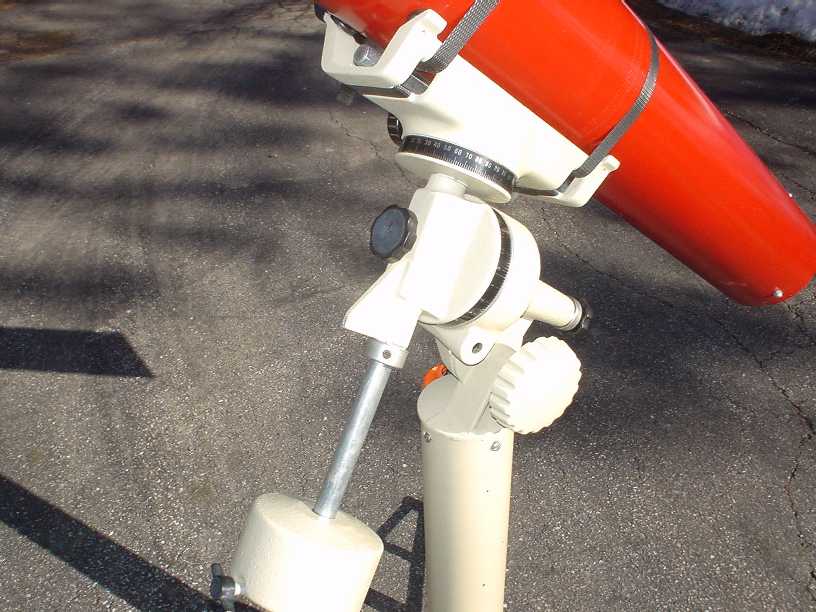
So while Edmund had made strides, they hadn't done enough. Meade, for example, was already using secondary spiders, real honest-to-goodness hinged OTA rings, and focusers that resembled fine jewelry. Their mounts were excellent. This was not lost on the buying public, and the writing was on the wall for Edmund (I've said this before, but I think Meade reflectors from the late 1970s through the early 1980s -especially the Research Grade models- were the best telescopes they ever made.)
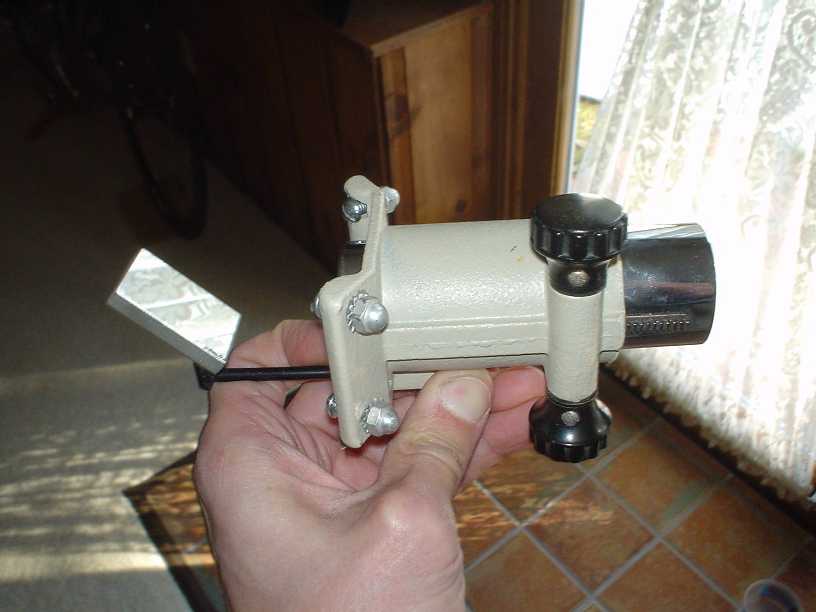
Optically, the scope is pretty good. The mirror is spherical, so it shows some undercorrection, but it's not serious, especially at f/10.6. Since you can't really get it collimated very well, precise viewing is kind of a lost cause. The scope seems to have some light-baffling issues. I'm not sure where the leaks are coming from, but I do note that the focuser is awfully close to the front of the tube. A few more inches of tube length would go a long way. If there's any stray light around, the entire view washes out in a sea of light brown. I tried to stay "authentic" by using the 6X30 finder and RKE eyepieces, but soon realized this was an exercise in frustration. Once I substituted a Rigel Quik Finder and my TeleVue eyepieces, things got a lot easier. It's wintertime here, and I cruised the winter sky - M42, M36, M37, M38, M35, M41, the Pleiades, etc. Low power views are decent if you're away from lights, but pump the power up a bit and the views start to fall apart.
Taking its limitations into account, it's not a bad little scope. However, the 4.25" f/8 Dob I recently cobbled together from spare parts is better, both optically and mechanically. Don't overlook these vintage scopes when they show up on the used market. They hark back to a time when telescopes were loaded with character, unlike the anonymous scopes of today. Desirable brands include Cave, Parks, Meade, Criterion, StarLiner, Quantum, Questar, etc. And Edmunds like this one. When I'm using it, I don't think about its awkward quirks; for a couple of hours during the night, it's 1979 again and I am one of those kids in that ad...
Hey, look - I wrote a review!
I've been actively involved with astronomy during the past year, but have been trying to avoid the equipment rat race. All I can say now is - y'all have been busy while I was gone! There's so much new stuff out there, I don't know how people keep track of it all. In the past year, you should know I've passed on reviewing a 25" Obsession, an FSQ106, and a TOA130. Yes, ~$21,000+ worth of optics have passed through my hands and I decided not to write about them. A $12,000 telescope that performs like a $12,000 telescope? Yawn. A $20 telescope that's going to change the world? Sign me up!
When I first started hearing about this scope, my reaction was probably the same as yours. A $20 plastic tubed refractor? Off to the junk heap with you! But hold on there a minute...Created for the 2009 International Year of Astronomy, the scope has genuine high-end aspirations. It was developed by real optical engineers, and people who care about what you get for your $20. The Galileoscope.org web site lists several impressive endorsements, including the IAU, NSF, Sky & Telescope magazine, and others (full disclosure - I have written for S&T, and Rick Fienberg, one of the members of the Galileoscope organization, is a friend.) The goal of the project was to get low cost telescopes into as many hands as possible, even adopting a "one telescope per child" model. Schools and organizations are encouraged to place quantity orders, perhaps into the hundreds, for discounts. The initial goal was to produce a $10 telescope.
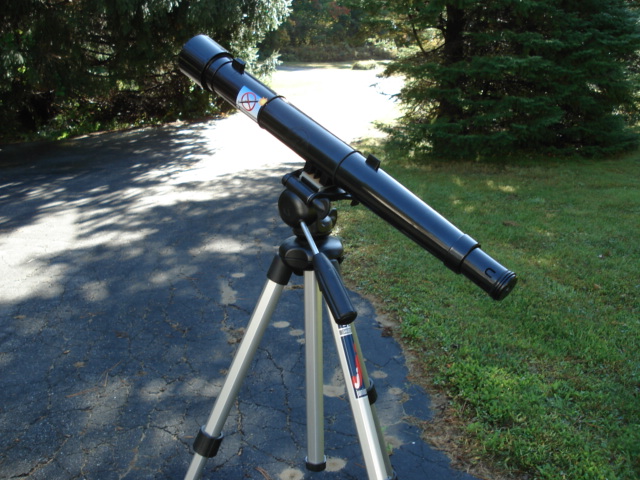
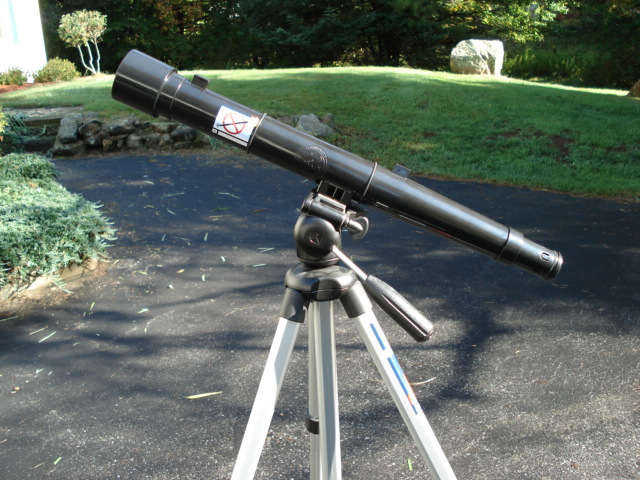
The Galileoscope, mounted on a Bogen Jr tripod. Raised nibs on top of the optical
tube are used for sighting.
They've clearly taken steps to insure that this isn't another department store junk scope. For starters, the two-element achromat isn't stopped down internally, and even appears to be coated. Also, the drawtube accepts standard 1.25" eyepieces - that's right, no trashy .965" eyepeices. Instead of attaching a throwaway optical finder, there are simple sighting bars on top of the tube. Reasonable powers - 25X and 50X are used - gone are the ridiculous "675X" magnification claims. The Galileoscope web site has numerous resources to help you if you get stuck.
When the scope was first launched earlier this year, the price had grown to $15. By early summer, the scopes were seriously backordered, and customers had to wait weeks for delivery. As of August, the price had risen again, to $20 (if you decide to donate one, the cost is still $15.) I started getting requests from novices asking for my opinion, and decided to check it out. I went to the Galileoscope web site, and got ready to place my order. Then I saw they were going to hit me with $14.55 for shipping. My finger hovered over the mouse, and wavered a bit at that point. Then I contacted local club members. It turns out one member had bought a couple of them and had one to spare. He dropped one off to me the next day.
I didn't have the "pleasure" of assembling the scope, per se. Apparently one consistent complaint of the Galileoscope is its confusing instruction set. I downloaded the instructions, and for a long time was confused about how to use the eyepieces. Although the scope was delivered to me assembled, I wound up taking it apart several times during the course of the review just to get familiar with it. The scope assembles with no tools. It's held together, variously, by snap rings and rubber O-rings. If you have a mind to, you can take the whole thing apart and stow the pieces away in a small bag or box. The plastic for the most part is thick and substantial. Fully assembled, the scope weighs a whopping 1 lb.
The scope comes with low power eyepiece of Plossl-like design yielding about 25X, which you put together yourself. Insert the barlow (a closely spaced doublet at the end of a 2" long extension tube) and the scope will do 50X. The barlow is confusing, as it looks like they've given you another eyepiece. If you put it into the focuser, it will yield an image, although not a good one. The drawtube is a friction-feed type with a locking ring. There is a dew shield, but no dew cap. Finally, there is a display stand so you can proudly...uh, display your scope at home.
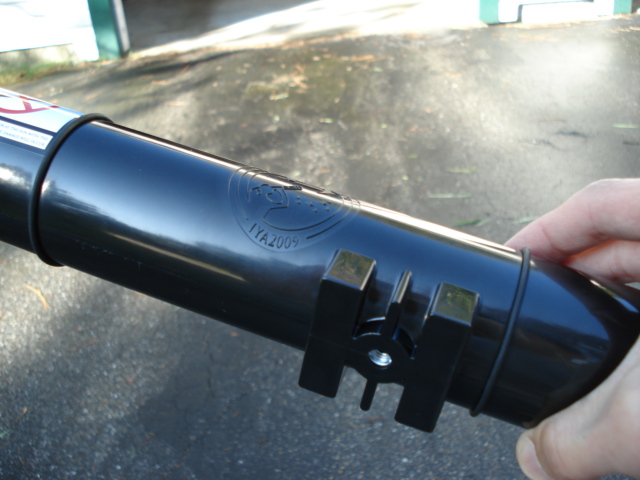
The scope attaches to a tripod using a 1/4" X 20 screw. The threaded nut is metal.
Although I was tempted to use a heavy mount and better eyepieces (more on that in a moment) I was trying to Keep It Real, doing what a novice might do with the scope. Therefore, I put the Galileoscope on the smallest and lightest tripod I own, a Bogen Jr (#3405 ) weighing about 4 lbs. Having said this, I think even the Bogen Jr is more substantial than many tripods in homes today. I worry about stability. But if you don't look too hard, the scope/tripod combination actually looks kind of cool.
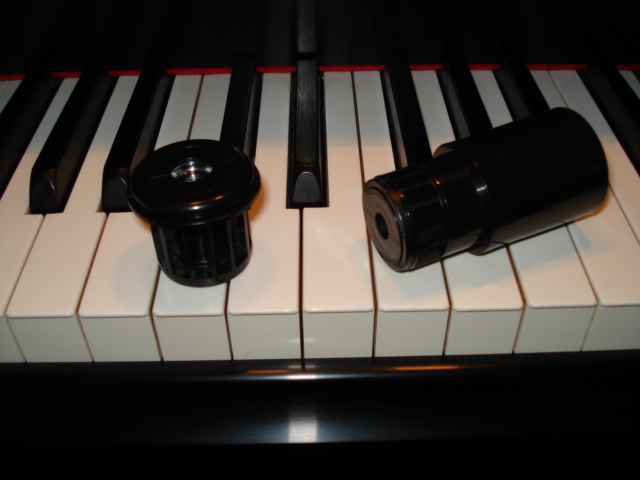
25X (L) eyepiece, and barlow/ extension tube (R)
So after all of this, how does the scope perform?
In short, surprisingly well. The scope is well worth your $20, and although there are issues (there are always issues) if you want to stop reading here and just place your order on the Galileoscope web site right now, you'll get no argument from me. The objective lens is quite nice - better than almost any department store refractor, and is worth the cost of admission by itself. It's capable of throwing up sharp images, and the star test yielded only minor undercorrection (nothing to worry about.) Since the f/ ratio is kept relatively long, and since it doesn't gather a lot of light to begin with, false color is kept at bay. The modkateer subculture out there is going to have a field day with this lens. I can already imagine the elaborate Galileoscope-based "overkill scopes" showing up at next year's Stellafane.
The moon looked quite nice. Craters on the terminator looked crisp at 25X. While there was only minor false color on the limb, a bigger problem is glare. The dew shield is short, and the unbaffled tube, while black, does seem to reflect quite a bit of light (again, another project for the mod-crowd out there.) On the night of September 29th, Jupiter was about 2 degrees away from the moon, and while looking at the planet, the entire field of view was washed out in white. Speaking of Jupiter, two bands are easily visible at 25X, as are the four moons.
Moving up to 50X, things got a little rough. Tripod shake becomes an issue, but once the shakes settle down, the images of the moon, Jupiter, and stars usually remained sharp. Deep sky images got a little dim. Still, I preferred the views at 25X and stayed there for most of my observing. By the way, I don't know if they designed it this way, but eye relief is comfortable. I could observe with glasses on with no problems.
Encouraged by the views of the easy stuff, I decided to see how "deep" the little scope would go (the following observations were all done at 25X.) Mizar and Alcor were easily split. Albireo was split as well, and the blue/orange color tints were readily visible. M13 is a dim smudge, M92 and M15 dimmer still. The Dumbbell is easy. The Ring Nebula is a little tough - it's bright but small, and just barely visible at 25X. The Double Cluster looks nice. I could just pick out M81 and M82.
One morning I got up at 4 AM and took the scope out to look at the winter objects. The Orion Nebula, the Pleiades, the Double Cluster, and the Andromeda galaxy were all very nicely framed at 25X. Open clusters like M35, M37, M36, and M38 were visible, but dim. I had a rough time seeing M33, but am holding out hope and will try for it again on another night.
After while, I decided I was tired of Keeping it Real, and mounted the scope on a Bogen 3001 equipped with a Telepod head. I also ditched the supplied eyepieces and went with a 19 mm Panoptic. Yes, I was now using $600 worth of accessories on a $20 tube, but everything got better. Mechanically the motions were smoother, and the Panoptic was a pleasure to look through (at 40% of the weight of the scope, it did make the rig back-heavy though.)
Keep in mind, all of these observations were done with a $20 telescope. It's really amazing that they managed to cram this kind of performance into a scope that costs next to nothing.
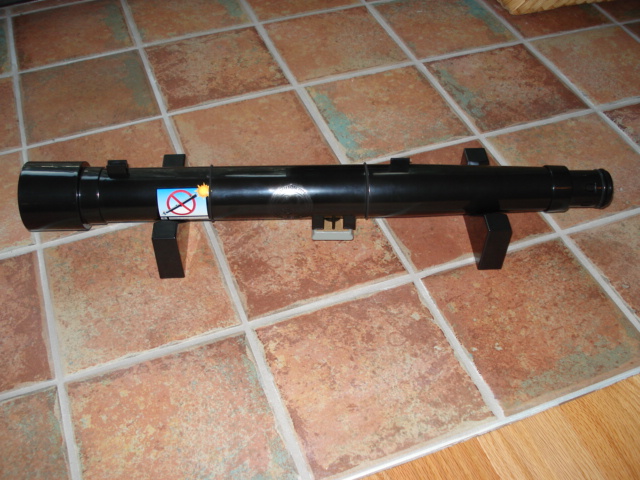
I like to display it next to my Katana!
Problems? Yes, there are a few. Complaining about this scope is a bit like stepping on a kitten, but since they market and sell this as a serious observing tool, I feel I should treat it as such. As I see it, there are three major issues:
1) The mount. The quality of your experience is going to depend so much on the steadiness of your mount. I can't overemphasize this. The problem is, the Galileoscope people have left this critical part of the equation up to the consumer, and based on experience, the Average Joes out there always overestimate how sturdy their tripods are. I can imagine people mounting the scope on a flimsy tripod that was "perfectly steady" for their little digital cameras and coming away frustrated. The Galileoscope web site does suggest a few suitable tripod models, but I don't think it goes far enough. I'd also suggest a minimum weight limit (I'd recommend something in the 4 lb range as a bare minimum.)
2) As noted around the web, and on the Galileoscope web site, the scope does not have enough in-focus travel to accommodate a diagonal. This is a real inconvenience. I live at 42 N latitude, and observing anything higher than Polaris was a chore (One reason I had so much trouble seeing the Ring is that it was directly overhead.) Looking at the scope, I think this is an easy modification. Shortening the tube and lengthening the drawtube would fix the problem (I think) at minimal cost. To keep the cost down, Galileoscope doesn't necessarily have to include a diagonal, they just need to made a provision for one. If this project is successful financially, could we see a modified Mark 2 version in the future?
3) When it's really dark out, it's hard to see the little finder nibs. I wound up just guessing where the tube was probably pointed, and the low power eyepiece offers enough field of view that panning around usually solved the problem.
That's about it. An additional "problem," if you want to call it that, was the limiting nature of any 50 mm refractor. There's only so much it can show you. After 10-20 minutes of observing, I found myself milling around, racking my brains for things to look at. But this was never intended to be a long-term observing instrument. It's a jumping off point for beginners, and in that regard it succeeds. In conclusion - and I never thought I would ever say this about a $20 telescope: Recommended.
Galileoscope Hots:
- Low price
- High quality objective lens
- Good views at 25X
Galileoscope Nots:
- Needs a sturdy tripod with smooth motions on the head
- Can't use a diagonal
- Finder nibs hard to see in the dark
I Reckon:
- Is that warm place frozen over yet? A serious observing tool for $20