
(Complete Version)
The Venerable Front-Runner: The Astro-Physics 130 EDT Astro-Physics refractors certainly need no introduction. These telescopes are so good that the term "Christen Triplet" is virtually synonymous with excellence these days. The 5.1" f/8 AP130EDT keeps falling into and out of the AP lineup. An f/6 version is also available. At $3650 for the OTA alone -- which could buy the other two telescopes combined -- it's by far the most expensive of the scopes tested, yet it has the least aperture. In other words, it's a typical high-end refractor.
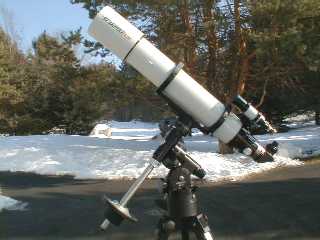
This particular sample of the AP130 has perhaps the most perfect star test I have ever seen. It is completely lacking in chromatic or spherical aberrations, and can be taken up to ridiculously high powers when atmospheric conditions permit. This telescope's reputation certainly preceeded it. Going in, many of us wondered, to varying degrees, how the AP could possibly lose. Was this blind prejudice, or informed bias based on years of experience? I was anxious to find out.
An Incredible Mirror: The Starmaster 7" f/5.6 Oak Classic At the other end of the aperture/price spectrum lies this unassuming-looking Dobsonian. Made by Starmaster for several years, these scopes have gained a cult-like following among reflector buffs. Sadly, they've been discontinued, and Rick Singmaster tells me he has no plans to bring the scope back. The world's the poorer because of it. There are only about 150 of these out there, which makes these scopes even more rare than Astro-Physics refractors.

All 7" Oak Classics are worth collecting, but the real stunners are the last 40 or so units with Zambuto mirrors in them. This particular sample's mirror has typically astonishing specs: RMS Wavefront Error: 1/74 Peak to Valley Wavefront Error: 1/29.6 Strehl Ratio: .993 The numbers only tell part of the story. The views through this telescope are stunningly vivid, sharp, and clear. Some of us have remarked that this telescope is like having a 7" apochromatic refractor for about $1000. Early versions sold for $695, while the last run of Zambuto-equipped units went for as much as $1000, depending on the options you wanted. On the used market, expect to pay as much as $1400, assuming you can find one. Although I expected the AP refractor to have the edge in winning this test, deep in my heart I was pulling for this little scope. My previous views through it suggested that it had more than a fighting chance (the owner has elong- ated the .45 arc-second B component of Gamma Andromedae and has no trouble seeing eight craterlets in Plato with it.) I mean, wouldn't it be a great story if a $695 scope managed to beat out a $5000+ refractor rig?
A Great Catadioptric: The Intes MN61 Once a curiosity, Maksutov-Newtonians are gaining well-deserved respect for providing crystal clear, pinpoint sharp, contrasty images. That they manage to do this at very reasonable prices makes them even more attractive.

The 6" f/6 Intes MN61 is also sold by Orion under the "Argonaut" name. The tube sells for $1150-$1350 depending on who you buy it from and what options you get with it. You can get Orion's Argonaut version with a GP-DX mount for $1999. Like the Starmaster, it has a tiny (18%) central obstruction, and the lack of a secondary support structure does a good job of convincing you that you're looking through a premium refractor. None of us have done extensive comparisons with this telescope, yet each time we look through it, or see it at a star party, it always elicits gasps from delighted observers. I've looked through some amazing Mak-Newts in my time, but I knew I wanted to include Allen's MN61 in this test. It is the best catadioptric I've ever seen. The MN61 comes into this test as something of a "dark horse" entry. One of us even cynically said that this comparo was really a test "between Mr. Christen and Mr. Zambuto" and that the Intes was just along for the ride. Would our prejudices hold up, or would the Intes surprise everyone and silently walk away with the crown?
The Stage is Set: The Observers We tested these scopes side by side. The AP130 was mounted on a Losmandy GM-8, and the Intes sat atop Losmandy's larger G11. After the comparisons, we each spent time with the scopes individually to form subjective opinions. Notes were privately taken, and we took care not to discuss our thoughts with each other before the test was concluded. At the end of the observing sessions, I collected and collated the data. Several observers participated in this comparison.
1) Dan S has twenty years of experience under his belt. Dan is well-traveled and has been to almost every major star party in the US. A patient and meticulous observer, Dan's skills came in handy during the limiting magntiude tests. He's owned over forty telescopes throughout his observing career.
2) Mike T is our resident refractor nut. He's a skilled star tester (most of the star testing comments are his) and loves to do high power planetary work and split tight doubles. Like Dan, Mike has also owned more than forty telescopes.
3) Chase M is a former club President and an enthusiastic photographer. He observes planets and double stars through his 4" Celestron ED refractor and his C8.
4) John P is a big fan of high quality Newtonians and spends every clear night he can under the stars. He owns two Starmaster reflectors.
5) Me (Ed), the writer. I've been involved in astronomy since 1979. Many of you know me through my writings, both in print and on the web. I'm primarily a deep sky observer. Equipment wise, I split my time between high quality Newtonians and apochromatic refractors.
It was a cold night with temperatures that dipped into the single digits. Seeing was in the "good" range, not outstanding, but good enough to obtain accurate and repeatable results. All the scopes were collimated and allowed to cool down thoroughly. Our first targets were Jupiter and Saturn. We were blessed with a wonderful night for observing Jupiter, as at least three of the Jovian moons were either in egress, ingress, or transiting. This allowed detailed comparisons between the three scopes. Right away I noticed two things. First, the Starmaster's images were much brighter than those in the AP or the Intes. This was not subtle. Even though it was still twilight, I was itching to run the limiting magnitude test right away to see how much deeper the Starmaster would go (luckily, cooler heads prevailed and we waited until later to do so.) Secondly, the Intes gave stunningly pinpoint-sharp images of Europa as it egressed off the limb of the planet. A good telescope should make the moon look like a tiny pimple off the limb. The Intes, like the others, showed this beautifully. Further- more, I noticed a wealth of detail on the surface of Jupiter. The red spot was clearly visible and I could see subtle shades of color on the surface. Moving to the Starmaster, I was distracted by the too-bright image and the diffrac- tion spikes off the secondary's spider. The AP gave stunning images too but I thought the Intes at least kept up. Hmmm...Was an upset in the making?

Our answer came a few minutes later. While the MN61 provided outstanding views, when the seeing settled down, most of us could make out more planetary detail, and higher contrast, in the other two scopes. In the end, four out of five of us voted for either the AP or the Starmaster in the planetary section of the test. We moved to M74 as a test of low-level contrast. M74 is a galaxy with extremely low surface brightness and is the bane of every Messier Marathoner. Here, the refractor stayed true to its high-contrast roots, easily showing the galaxy as a pretty smudge against a pitch-black sky. The Starmaster easily caught it too. I could see a brightening towards the center of the galaxy in the Starmaster that was very hard to see in the AP. The Intes, with its many optical surfaces, almost failed to catch the galaxy at all until I pushed the power up, used averted vision, and tapped the tube to make the image move. Furthermore, I noticed the sky background in the Intes wasn't as black as in the Starmaster or the AP. The AP and Starmaster clearly caught the galaxy, but it was nearly invisible in the Mak-Newt. In fact, one observer declared that he never saw the galaxy at all through the MN61.
Out of curiousity, we set up an Astro-Physics Traveler, the 4" version of the AP130EDT, nearby. It had no trouble detecting M74. Moving on to the star test, all three scopes have outstanding optics. The AP is just about perfect, and the Starmaster has a very slightly undercorrected mirror. The Intes was slightly overcorrected. No false color was noted in the refractor. The real surprise here was the Intes, which easily showed the best star test of any catadioptric telescope I have ever seen (many cata- dioptrics made today - especially Schmidt-Cassegrains - make a mess out of the star test.) These slight aberrations are purely academic and have no effect whatsoever on the in-focus image quality. Call this one a tie. All three telescopes are superbly corrected for field flatness. Even at low power, I could focus on a star in any part of the field in any of the three scopes and could count on the rest of the field also being in sharp focus. Call this one another tie. I sent Dan, who is an unusually patient observer, into a corner alone with his star charts to determine the scopes' limiting magnitudes. The common procedure here is to use M67, the open cluster in Cancer, but the cluster is too low in the sky at my 43 degree north location, so we settled on NGC 1778 in Auriga, which was riding high overhead. The magnification was kept around 130X in each telescope during the test.

Conventional wisdom states that the more elements there are in the optical path, the dimmer the images should be. Would practical observation support this? On this night, the 7" Starmaster reached down to 14.3, while the 5" Astro-Physics penetrated to about 13.9. The 6" Intes finished last at 13.7. Yes, the refractor penetrated two-tenths of a magnitude deeper than the Mak-Newt, despite having less aperture. Running the numbers, the AP behaved as if it had about 5% more aperture than the Intes, despite actually having 38% less. This does give some support to the theory that multiple surfaces do have an effect on light throughput. It also supports our subjective opinions; every observer present commented, at one time or another, on the dim images in the MN61. (Update, 3/10/00: On a later night, I sent Dan out with the 20" Obsession to check out its limiting magnitude on M67. Readers should keep in mind that this was a different night, on a different object. The Obsession went down to 15.3, or about one magnitude deeper than the 7" Starmaster. Interestingly, theory predicts the difference should have been closer to two magnitudes.) Later on in the evening, we spent time casually looking through all of the scopes at whatever struck our fancy. A couple of us commented that the differences we noted during the formal part of the test seemed to diminish during casual use.
All the scopes were superb. However, I did notice that people tended to crowd around the AP or the Starmaster. We pointed all the scopes at M81/M82, M42, NGC2392, M46/NGC2438, M45, M1, the Double Cluster, and many other objects. At high power, the companion to Rigel was clearly spotted in the Starmaster and the AP, but only marginally in the Intes. During this informal part of the evening, I made some mental notes. There were a couple of consistent comments made. The MN61 seemed dim - at one point, someone actually thought the Mak-Newt was operating at a higher power than the others, and asked to drop its magnification. In fact, all three scopes were operating at about the same power. Also, all of us were astonished at how good the views were through the Newt- onian. This is in spite of the fact that many of us already own Zambuto-equipped telescopes (I guess we needed a reminder!) For myself, looking through either the Starmaster or the Astro-Physics reminds me of a paint job I once saw on a Ferrari. The views were deep and rich, and I felt as if I could fall right in.
The Final Tally After a few hours of this, we decided it was a good idea to get out of the bitter cold and we retired to a local pizza parlor to discuss the results. The comments were interesting. The votes were split between the 7" Starmaster and the 5" Astro-Physics. Which way each observer voted hinged, without exception, on one aspect -- whether the observer was bothered by the diffraction spikes of the Newtonian's secondary spider on bright images or not. A couple of us (myself included) find these spikes distracting. At one point, I could not locate one of the moons egressing off of Jupiter's limb because it was caught in the glare of one of these spikes. To those not bothered by this, however, the Starmaster was at least the equal of the Astro-Physics. In the end, the Starmaster captured five out of the ten first place votes on the planets (five observers ranked views on both Jupiter and Saturn), while the AP got four first place votes. On deep sky, the Starmaster got three out of five votes, while the AP got the other two. And what of the Intes? Though oustanding, the Mak-Newt was downgraded slightly due to its slightly softer contrast, and its somewhat limited light throughput. On the planets, the Intes finished last in eight out of the ten votes cast, although it did receive one first place vote on Jupiter (mine). On deep sky, the lack of contrast scored it last on all ten of the votes cast. The Astro-Physics didn't get a single last place vote in any category. A test like this one tends to accentuate problems. In truth, the differences between the scopes are small. To illustrate this, we compared all three to a TeleVue Pronto, an excellent portable semi-apochromat. We like Prontos - three out of five of us own one. It put up an excellent fight, but the little refractor threw up some false color on Jupiter and didn't gather enough light to get M74 from my location. This one was undercorrected by about 1/4 wave. The poor Pronto would have finished last in all the ranked tests. However, when these scopes are not around, we are quite happy to look through our Prontos, and do so all the time.
Which would you buy?
This is a loaded question, since two of the three scopes are either not cur- rently available or nearly impossible to get. At this writing, only the MN61 is "available", either through Intes dealers, or from Orion under the "Argonaut" name. Still, I posed the question: If price were no object, which one would you buy? Four out of five of us picked the Astro-Physics, despite the refractor having been clearly outscored in the voting. Why? "Contrast", "super-sharp images", "fit and finish", "resale value", and "mystique" were the answers most commonly given. "The AP does the least amount of damage to the image," said one observer. "Sure, I voted for the Starmaster more often," said another, "but if I had to own only ONE scope for the rest of my life, it would be an Astro-Physics refractor." Interestingly, the fifth observer said he would pick the Starmaster even if price were no object -- quite an achievement for a $695 telescope. There is one other reason to pick the refractor -- with no last place votes in any category, it didn't come close to doing anything wrong (other than costing too much.) The Starmaster has the potential problem with diffraction spikes, while the Intes had the contrast and light throughput issues. The AP is like the team in the playoffs with the bye week. Let the other two guys beat each other up, then pick up the spoils. And with price as a consideration, which one would you buy? Two of us jumped ship to the Starmaster once price was factored into the equation. Thus, three of us favored the Starmaster, while the other two declared that the Astro-Physics was still the one to own, even with price as an issue.
Conclusion
So, what are we to make of all this? Going by the numbers, the Starmaster wins. It has a killer mirror, gathers enough light to do serious deep sky work, is easy to set up, and looks great on planets.

Factoring desire into the equation, the Astro-Physics wins. It's the most consistent of the scopes, with legendary optics, incredible contrast, and it's got that indefinable "refractor mystique" that everyone seems to want these days. Check with AP if you want one (they make f/6 and the f/8 versions, but not both all of the time), and be prepared to wait two years or more after you put your name on the waiting list.

And what of the Intes? It's still a world-class telescope, with refractor-like pinpoint sharpness, with superb planetary images. It's highly recommended for quality-minded observers. Also, in fairness to catadioptrics, there are superb Mak-Newts from Ceravolo lurking out there, and Astro-Physics has been demonstrating their 8" and 10" Maksutov-Cassegrain scopes at star parties for years. This raised some ques- tions as to how these scopes would fare, had they been available for this test. Also, the unusually dim images in the MN61 caused one observer to state that we should have used the 8" version, the MN86, instead. Finally, although I am confident that these results are repeatable by anyone who wishes to try this test, it would have been nice to use the scopes over several nights. So you see, this article is far from the last word on this topic. Use it instead as a jumping-off point for your own research. Later on in the evening, other observers showed up, toting two more 7" Star- masters. An Astro-Physics Traveler, a 10" Starmaster EL, and the 20" Ob- session were also present. Our ultimate conclusion is that it's really decadent to have this many good telescopes in one place at one time. But hey...we can handle it.
OK, so you've just finished reading this article and now you're shaking your fist at the terminal because you can't get these tele- scopes. Fortunately, there are some alternatives. If you're dying to get your hands on one of the APs, you have a few options. Aside from putting yourself on the waiting list and hoping, you can get a Takahashi FS128, which has nearly identical performance. The problem is, the Tak will set you back a cool $5200 or so (yes, it's $1550 MORE than the Astro-Physics), and you will still need to buy a mount, finder, diagonal, etc. Also, you can scale back your ambitions a bit and get a premium 4" apochromat like the Takahashi FS102 ($2500) the TeleVue 101 ($2750) or the Vixen fluorite (available from Orion, $2500.)
The 4" TMB Fluorostar is another fine alternative. Discounts are commonly available; check before ordering. If it's the 7" Starmaster you want, check out the larger models in Starmaster's line, including the 10", 11", and 12.5" EL models ($1900-$2500.) They're not as portable as the 7", but you still get a Zambuto mirror. Starsplitter makes a Zambuto-equipped 8" f/8 "APO Eater" Dobsonian for $1400. The Teleports are becoming available again also, in limited numbers. Finally, you can get one of the Portaballs: the 8" f/6 sells for $1300+, the 10" f/5 is $1900+, and the 12.5" is $2900+. All come with Zambuto optics. The Intes is available from Intes dealers like ITE, Earth & Sky and APM (in Europe.) Also, you can get the "Argonaut" version from Orion, which comes prepackaged with a nice GP-DX mount. The 5" f/6 version, the MN56, is also superb and is a little lighter and cheaper at $795. If you're strong of build and thick of wallet, you might go for the larger 8" Intes MN86 ($4300). None of these telescope models exactly grow on trees, but at least you have some alternatives to look at. Good luck, and happy hunting.