By Ed Ting
Updated 12/13/00
2) Orion Argonaut 150 (Intes MK67)
3) DGM Optics 4" Off-Axis Newtonian
5) Starmaster 11" EL Dobsonian
6) Takahashi FCL "Sky 90" Refractor
(102" f/6.5 ED doublet air-spaced refractor, GP mount, 6X30 finder, diagonal, 20 mm Lanthanum eyepiece, $2199 complete, $1499 OTA only)
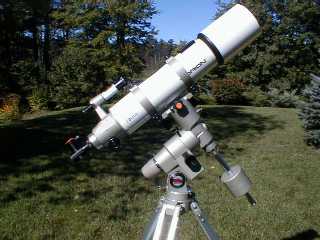
"It's a poor man's Traveler" said one observer. I'm not sure any $2000+ product can be considered a "poor man's" anything, but I think I see his point. It's a compact, quality-minded refractor at an attractive price. Made by Vixen, this telescope is sold in the US under the Orion name. I get asked about this model a lot by readers. A local club member bought one recently and I was anxious to test it out. The scope is really compact, about the size of the Astro-Physics Traveler, but lighter.
This sample has outstanding spherical correction - better than 1/4 wave. There is a trace of color around bright objects like Altair, Vega, or the moon. As a reference, it has much less color than a Ranger/Pronto, but is not quite to the "whiteness" of a Takahashi, AP, TV102, or Vixen's VX102FL fluorite models. While all of us noticed the false color, none of us were especially bothered by it. The contrast is superb as well. The tube is oversized and is baffled internally. The 20 mm Lanthanum eyepiece is of very good quality, although it has a rather narrow FOV. If you want to use 2" eyepieces, there's a cheap ($37) 2" visual back available (not tried.) The 6X30 finder is also of good quality, refreshing in this age of fuzzy, dim finders. We spent a few evenings looking at the summer Messier objects and the moon. I had it set up next to my Traveler, which probably isn't fair, but the 'lil Vix acquitted itself surprisingly well. At lower powers on showpiece objects like the Ring, Dumbbell, M13. M15, M2, M92, etc, there was little to choose between them. The Double-Double was an easy split at 95X, as was Alpha Hercules. With a 35 mm Ultrascopic and an OIII filter, you can almost see the entire Veil in one view. It was only when looking at bright objects, or when the powers climbed above 175X or so (or a combination of the two) did the Traveler start strutting its stuff - its images remained tighter and sharper as the magification climbed. It's a good-looking scope and generally draws a small crowd at star parties.
Although its optics are excellent, some do not like Vixen- based mechanical assemblies. First and foremost on the complaints list are the focusers. Some are too loose, and some are "grainy" to the touch. The focuser on this one is set way too tight - I keep absent-mindedly loosening the focus lock knob, thinking the guy before me has torqued it down. Also, the lens cell has no adjustments. The RA and Dec levers are made of cheesy, loose plastic and fall off a lot (the owner has replaced them with radio-style knobs.) Finally, the coatings on the lenses don't seem quite as dark as on the VX102FL. It's a very nice telescope for the price. If you're a real stickler for optics, get the f/9 fluorite VX102FL version instead. If you're a stickler for optics AND mechanics, look at a Takahashi, TMB Fluorostar, TeleVue 102 or TeleVue 85, or an Astro-Physics if you can get one. Recommended for refractor lovers on a budget. (Addundum: I get a lot of e-mail on this model. Owner response is generally very positive, but I have heard of a couple of optically eccentric units out there. One owner told me he eventually traded in his VX102ED for the VX102FL. Due to time, distance, and the large volume of e-mail I receive, I can't confirm or deny these reports. But I thought this was worth passing along to readers. Keep in mind, Orion has a generous return policy, so you should be safe either way. Still recommended.)
2) Orion Argonaut 150 (Intes MK67) 10/9/00
(6" f/12 Mak-Cass, 7X35 finder, no diagonal/eyepiece, Sky View Deluxe Mount, $899 OTA/case only, $1099 complete) (No photo available)
Thanks to cheap Russian optics by Intes, Maksutov-based telescopes are now entering the mainstream. This MK67 is sold by Intes dealers with a white tube and blue lettering, while the Orion version has a black tube with white lettering. I spent about four hours helping a first-time owner and was able to get a good handle on its performance during the evening. Those of you familiar with these Russian scopes will find no surprises - the telescope has excellent optics and quirky mechanics at a bargain price. This sample arrived rather significantly out of collimation. It took me close to half an hour to get the alignment back. This accomplished, the scope gave excellent views. The optics are slightly undercorrected and the scope throws up an excellent star test. I've said nasty things about the Sky View Deluxe (and all of its nameplate-brothers) but the Argonaut is so light (9.5 lbs) and so short that the SVD turns out to be just fine for this tube. There's a nice carrying handle on top, which provides a convenient grab point for manually slewing the scope. I also like the soft-sided carry bag, which you can carry on to an airplane. I spent an enjoyable evening testing this scope alongside my 10" Starmaster EL, which contains a mirror by The Amazing Carl Zambuto, and throws up per- haps the best images of any telescope I have ever owned. Despite the com- petition, the Argonaut kept up quite well, although it was limited by its 6" aperture. We looked at M13, M92, M57, M27, M71, M56, M8, M17, the Double Cluster, the Veil, and (later) Saturn and Jupiter. I could detect a slight loss of contrast compared with the Starmaster, and the mount starts to get shaky once you get up to around 175X-200X. If you're a high-power kind of guy, you should consider an SP/GP/CG5, or better (warning: you may have to make a custom plate with these mounts.)
It wouldn't be a true Russian telescope without a few mechanical oddities. The Argonaut is no exception, but the quirks are thankfully few in this case. With a 2" diagonal in place, many 1.25" eyepieces will not come to focus in a standard 2"-1.25" adapter. So if you switch back and forth between 2" and 1.25" eyepieces, you have to switch diagonals as well. The finder is OK optically, but it gets knocked out of focus quite easily (you focus by turning the eyepiece.) Finally, the "instructions" are pretty bad, and will likely stymie a first-time observer. The scope is available for slightly less money through Intes dealers, but if you work with Orion you get their outstanding service and reassuring return policy; I think it's worth the extra (I also like Orion's graphics better.) Note that you do not get an eyepiece or diagonal with the scope; budget accordingly. The Argonaut has excellent optics, few mechanical quirks, it's sized for travel, and is very attractively priced. For not much more money, it's more durable than Meade's ETX125. I think its optics are within striking distance of the magnificent Questar 7, without the Q's breathtaking price tag. The Argonaut is a fine telescope for those with an upper-class eye on a middle- class budget. Heartily recommended. What are you waiting for?
3) DGM Optics 4" Off-Axis Newtonian 11/20/00
(4" f/10 off-axis Dobsonian, $745-$895 net, $575-$725 OTA only)
I first saw this Baby DGM at NEAF 2000 and was immediately intruigued. Having been impressed with the larger 5.5" version, I asked owner Dan McShane for a review sample.
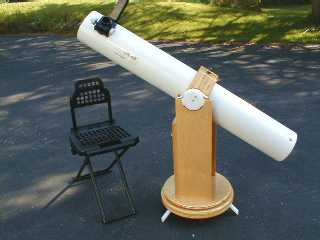
Many owners of larger Newtonians sometimes mask off a large portion of their mirror to do planetary work. The smaller aperture, lack of central obstruction, and increased f/ ratio can improve the image tremendously. An off-axis tele- scope like this ones goes one step further, giving you one "piece" of the mirror, permanently mounted. McShane doesn't like to reveal too many of his secrets, but these 4" off-axis mirrors are apparently cut from a larger 10" "parent" mirror of high quality. He takes over from there, building solid, stable, and well-finished mechanical assemblies around the mirror. It's cute. If you didn't look too hard, you'd be convinced it was a conventional 6" Dob with really nice woodwork. Looking down the tube, however, you see a cute little 4" mirror, and the secondary is mounted right under the focuser. The workmanship is top-notch, right up there with Obsession, Starmaster, etc. No finder was supplied, so I attached a spare Rigel Quik Finder. The first sample I acquired was apparently a pre-production unit with a rack and pinion focuser. Unfortunately, the rocker box was cut too low to balance most of my larger TeleVue eyepieces when pointed at the zenith. Also, the optics showed up some astigmatism on the star test.
Upon receiving the sample back, McShane told me there were some placement problems with the secondary. A second sample was delivered. This one was on its way to a customer, who asked me to check it out. The star test also showed a trace of astigmatism. McShane came over to my house when he heard this, genuinely concerned. He gave me a quick lesson on collimating these unusual telescopes. I thought I had understood the collimation procedure, but it turns out I did not. Once properly aligned, the star test looked nearly perfect. It was strange to see no central obstruction on a Newtonian's star test. Therein lies the only criticism I can find of these telescopes. According to McShane, accurate collimation is absolutely essential on these off-axis Newts (I can attest to this, after watching Dan tweak this sample.) There are instructions on his web site, but I got confused by them, and so might you. McShane is currently working on a new set of collimation instructions which includes plenty of pictures so you won't get led astray. Going through all of this is worth it - images produced by this telescope are wonderful. We looked at the double-double at 275X and all four components were still tight little round balls. The contrast was impressive, too. You could have easily fooled me into thinking I was looking through a world- class 4" apochromatic refractor. I did some quick comparisons with my Traveler. While the AP threw up a slightly brighter image, there was little to choose between the scopes. Not bad for a $745 Dobsonian. Also, the scope responds extremely well to the Celestron Anti-Vibration Pads. I found I could push powers almost 50% higher with the pads, than without them. The price of the scope varies, based upon the kind of tube you want - PVC or fiberglass. Highly recommended, for those willing to learn how to collimate it.
4) Orion XT 6 Dobsonian reflector 12/4/00
(6" f/8 Dobsonian, 25 mm, 9 mm Plossls, 6X30 finder, moon filter, CD ROM, $369 + $39 shipping)
One of the frustrating aspects about buying equipment for this (or any other) hobby is that you wind up spending a lot of money, just to learn that you didn't have to spend a lot of money in the first place.
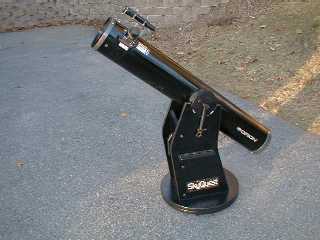
Take, for instance, this fine Dobsonian from Orion. It's got good optics, a decent 6" of aperture, comes with an nice array of accessories, and is reasonably priced. Perhaps most significantly, there are no signs of cost-cutting or cheapness in the product, very rare at this price level. On the contrary, the fit and finish is really nice - the scope looks and feels as if it costs a lot more than $369. This sample has only a trace of undercorrection, nothing much to worry about. Cassini's Division is easy. Shadow transits on Jupiter are easy. Showpiece objects like the Ring, Dumbbell, M13, etc are bright and clear. The CorrecTension spring-loaded altitude bearing works well; I had no difficulty tracking up to about 175X-200X. The central obstruction is a stingy 20% and the secondary is mounted on a good quality 3 vane spider. The primary is mounted in a push-pull cell (not spring-loaded.) The focuser (1.25" only) is very smooth, and the supplied Plossls are of OK quality. Orion's customer support is superb and should be a model for this industry.
There are a few complaints, none of them especially serious. The mirror is plate glass, but at the 6" level any mirror tends to cool down pretty quickly anyway. The metal tube is closed and rather small (around 7") though, so do allow for a little cool-down time before observing. The focuser's drawtube extends pretty far into the light path, which made reading the star test a little difficult. The base is rather heavy at 24 lbs, but does lend some stability to the setup. Finally, the focuser is mounted on the left-hand side of the tube - fine for southpaws like myself, but you righties out there might have to take a few minutes to adjust. As stated, none of the problems are serious. In fact, the list of com- plaints is remarkably short and benign for a telescope this cheap. The XT 6 is recommended as an ideal beginner's scope and a fine back-up/ star-party scope for more advanced astronomers. If you're feeling am- bitious, the 8" XT 8 buys you another .6 magnitudes for $499. Orion has just introduced 4.5" and 10" models into the lineup. Highly recommended.
5) Starmaster 11" EL Dobsonian 12/4/00
(11" f/5.4 Dobsonian reflector, shroud, $2295 + shipping) (see also review of 10" version)
Physically identical to the (now discontinued) 10" EL reviewed a year ago, the 11" version of Rick Singmaster's popular premium Dob features a bigger increase in light gathering than you might think - close to 1/2 magnitude.
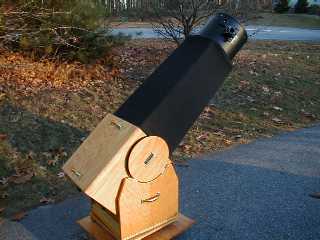
There are some minor changes made to the structure to accomodate the larger mirror. The shorter focal ratio (f/5.4 vs f/6 on the 10") results in a slightly larger secondary, although the central obstruction % is said to be the same. Newer models have a different secondary cage. The Sonotube is replaced by a classier-looking kydex/wood ring arrangement like on the Starsplitters and Obsessions. The focuser is an excellent JMI unit. For an extra $60, Starmaster will install a permanent secondary heater that runs off a 9V battery. This increases your central obstruction % a bit, but it will keep you observing on those dewy nights. The mirror is beyond reproach, another brilliant work of art by Carl Zambuto. At times it feels as if you're looking through an 11" apochromatic refractor. These Zambuto-equipped telescopes made it possible for you to do serious planetary/double star work, right alongside your refractor-loving friends. Under dark skies, I was surprised at how much deeper the 11" went than my own 10" EL. It was easier to see the components of Stephans Quintet, for example, and after spending a little time with this 11", going back to my own (superb) 10" felt like I had just put on sunglasses.
Like all ELs, the upper half of the telescope comes apart, truss poles and all. Collimation is easy thanks to high-quality cells and hardware. The side bearings are Starmaster's industrial velcro/teflon arrangement, which allows for incredibly smooth tracking even at high (250+) power. The woodworking is superb, right up there with the Obsessions. As of this writing (12/00) there is a waiting list of about 4-6 months. This isn't bad; I waited almost as long for my last Meade Starfinder. The 11" EL has killer optics, is easy to set up, is beautifully made, is reasonably priced, and the friendly customer service from Rick and Carol Singmaster is second to none. Highest recommendation.
6) Takahashi FCL 90, aka "Sky 90" 12/13/00 (90 mm f/5.6 fluorite doublet apochromat, OTA only, $2295 net) (Serial # of unit reviewed: 00012)
Here's Takahashi's 90 mm f/5.6 answer to the Astro-Physics Stowaway. This unit is one of the first to be shipped to the US, and upon seeing its tiny stature - not much larger than the attached 7X50 finder - I got very excited about testing it. The tube is incredibly tiny - 13.5" with the dew shield retracted, and 16"-19" extended with the visual back attached. Tube weight is about 7 lbs. It would probably fit in a thick briefcase. This thing is a travel scope if there ever was one.
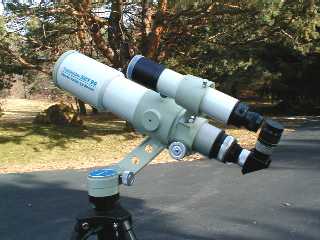
The Sky 90 is a departure in many ways from traditional Takahashis. The retractable dew shield is a first in my experience. Unusually for a Tak, the lens cell has no push-pull adjustments (even the diminutive FC50 has them.) Also, this is the fastest optical train in the FC/FS line. All of this suggests that the scope was manufactured as a reaction to certain market conditions, rather than something they might have other- wise wanted to do themselves. The scope was shipped for use "Japanese style" ie, for straight-through viewing, with a set of well-made adapters that caused momentary confusion as I tried to figure out how to equip it for 1.25" diagonal use. There's a set of instructions for the FS series that makes no mention of the Sky 90 at all (there is a small, one-page insert describing the options.) The focuser is the typical, buttery-smooth Takahashi unit so many of us have grown to love. Potential buyers need to keep in mind that the asking price is for the OTA only - I had to attach the finder, finder bracket, diagonal, and then I had to figure out how to mount it. The rig you see above lists for around $3200. Figure your budget accordingly. I used the Sky 90 over a period of three evenings in early December.
I did not have a Stowaway on hand, but I did have many other competitive telescopes, including a Traveler and two FC76s nearby for comparisons. This Sky 90 sample exhibits very light undercorrection, perhaps 1/4-1/6 wave. There is minor false color around bright objects like Venus, Jupiter, the limb of the moon, and brighter stars like Vega and Capella. In comparison, the Traveler and both FC76s are at down near the 1/8 wave level. The FC76s both had less false color than the Sky 90, and the AP was essentially color-free. How offensive the false color is on this Sky 90 depends on your personal sensibilities and tolerances. On the one hand, this is the first Takahashi fluorite I've seen where I was occassionally conscious of chromatic aberration. It's very mild, but it's there. On the other hand, it is absolutely remarkable that any doublet this fast (f/5.6) can exhibit so little chromatic aberration. As a baseline, it has less false color than Meade's ED refractors, and much less than the Ranger/Pronto duo.
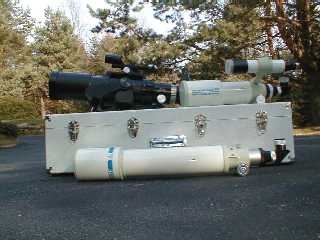
I ran some viewing comparisons on Saturn, Jupiter, the moon, and the winter Messier objects. The Traveler was clearly the best of the field and won every comparison, so I set it aside. The real contest turned out to be between the Sky 90 and the two FC76s. Images were superb in both the 76s and the 90 - ten belts or more visible on Jupiter, and Cassini's Division was visible all the way around under steady conditions. The views were essentially the same, with the Sky 90 throwing up a brighter image and picking out more dim moons around Saturn. Images were rock steady and razor sharp on Saturn at 225X. On Jupiter, the Sky 90 threw up a very minor purple halo. Turning to deep sky the Sky 90's 1/2 magnitude advantage - critical at these small apertures - gave it the edge on every Messier object I looked at. This, coupled with the famous "Tak contrast" suggests you might be able to do semi-serious deep sky work with it in a pinch. Even under a nearly full moon, I had no trouble seeing M33 and NGC404. The FC76s saw them too, but less conspicuously. But let's be serious, no one buys this thing for its deep-sky performance. It's nice to know, however, that you can look at some reasonanbly dim extended objects if you had a mind to. I looked at M35, M36, M37, M38/NGC1907, M42/M43, M78, M41, etc. So where does this leave us? I would still rank the Sky 90's performance as world-class, but I thought the FC76s kept pace remarkably well, for hundreds less. If your priorities are extreme portability for frequent and rugged travel, or extreme speed for photo/CCD work, the Sky 90 is self- recommending. It will also more than hold you over until you can locate a you-know-what. If your needs are more generic, however, I'd suggest an FC76/FS78, or better yet, an FC100/FS102.
End Telescope Reviews, Page 14